Articles tagged “BBC BASIC SMS”
Arcs, segments and sectors in BBC BASIC for the Sega Master System

More musing on tape phases I bought a few more Acorn-format BBC BASIC cassettes to test my adaptation of BBC BASIC to the Sega Master System with, and have found a few interesting oddities since my last post. In that post I made the assertion that the phase of the recorded signals on the tapes is at 180°, i.e. each wave cycle goes negative before it goes positive (whereas a 0° phase would go positive before it goes negative). This matched the documentation I'd read, the output of tools like PlayUEF and my own tests with commercially-recorded tapes.
BBC BASIC Electronics Sega Sega Master System Tape loader Z80 BBC BASIC SMS
Tape cycle frequencies and phases, plus VDrive3 support for BBC BASIC on the Sega Master System
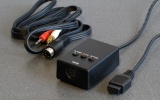
I have now moved the tape interface circuit described in the previous entry from its breadboard prototype to a neat enclosure where I am happy to report it mostly works as well as it did before. I have spotted two issues, though. The first affects my small cassette recorder but not the large one, and is related to reading files from tape via the file IO routines (such as OPENIN then BGET# to retrieve a single byte, not from LOAD). Files are stored on tape in 256 byte blocks, and when the file is opened a whole 256 byte block is read from the tape and copied to the Master System's RAM.
BBC BASIC Electronics Sega Sega Master System Tape loader USB VDrive Z80 BBC BASIC SMS
Refining the tape interface for BBC BASIC on the Sega Master System
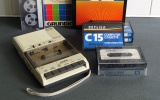
It's been quite a while since my last post but work has continued with the version of BBC BASIC (Z80) for the Sega Master System. Most of the features I have been working have not been particularly exciting to write about on their own, but here are some of the notable changes:
All VDU code (for text and graphics output) has been moved to a separate ROM bank, freeing up around 16KB of extra ROM space. It makes calling the code slightly more complicated but in the previous post I mentioned that I had less than 100 bytes of free ROM space so this was definitely required.
BBC BASIC Electronics Sega Sega Master System Tape loader Z80 BBC BASIC SMS
Loading BASIC programs from cassette tape to the Sega Master System
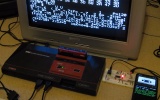
After I posted about the pattern filling modes on Twitter I was alerted to the BBC Micro Bot website which hosts a gallery of programs that produce impressive graphical output from very short BASIC programs (short enough to fit in a Tweet!)
I tried a few of them out but unfortunately ran into problems with a lot of them that use various tricks to reduce the original program text length by embedding non-ASCII characters directly into the body of the program. My usual approach to prepare programs was either to copy and paste them into an emulator (my emulator strips out non-ASCII characters on pasting, as these can't be mapped to keystrokes) or to save them to a file and transfer that serially, and my own editor's tokeniser and BBC BASIC for Windows both had a habit of mangling the non-ASCII characters.
BBC BASIC Cogwheel Sega Sega Master System Tape loader Z80 BBC BASIC SMS
Patterned fill modes for the Master System version of BBC BASIC

One of the features I was quite happy with in the TI-83 Plus version of BBC BASIC was the dithered fills used to provide some semblance of different colours. Sixteen different patterns were provided between black and white:
As well as baking in the sixteen different dithered patterns I added a command that let you use your own pattern tile in a very hacky method (you'd allocate the memory for the pattern via DIM and then pass the address of that memory to GCOLPAT – the extra "PAT" statement after GCOL is what did the trick).
Better plotting modes, text anywhere on the screen and double-height characters for Sega Master System BBC BASIC

I've made quite a few changes to the way colours and plotting modes are handled in the Sega Master System version of BBC BASIC; previously this was handled on a per-graphics-mode driver basis, but this resulted in a lot of duplicated code and some inconsistencies. The new code is a bit more straightforward but also adds quite a few new features, most obviously different plotting modes:
Plotting with the OR mode The above screenshot shows the result of filling three circles with the OR plotting mode.
A four colour any-pixel-addressable video mode for the Master System

The video display processor in the Sega Master System is derived from the TMS9918A and provides a number of different screen modes. These modes are mostly character-based and generate the picture that is displayed on your TV based on two blocks of data in video RAM: the name table, which specifies which character appears in each cell on the screen and the pattern generator which contains the pixel data for each character. TMS9918A "Text" mode The "Text" mode is probably the most straightforward example.
Better drawing, editing, memory and emulation for BBC BASIC on the Sega Master System

I have continued to work on the Sega Master System version of BBC BASIC, and it's feeling much more like a practical version of BASIC than something that was just holding together to run one specific program! One of the key improvements is to standardise the handling of the different graphics modes. Previously I was using a coordinate system where (0,0) is in the top left corner and all drawing operations were carried out using physical device coordinates (so the screen was treated as being 256 pixels wide and 192 pixels tall).
BBC BASIC Cogwheel Electronics Emulation Sega Sega Master System Z80 BBC BASIC SMS
Running BBC BASIC on the Sega Master System

I've recently been spending some time finding a way to run BBC BASIC on the Sega Master System, inspired by BASIC Month 6: The Mandelbaum Set on the RetroBattlestations Reddit community. When this month's program was first announced I tried running it on my only unarguably retrobattlestation, my Cambridge Z88, but the screen's low (vertical) resolution didn't do the program much justice. I thought this gave me two options:
Control some external piece of retro tech to produce higher-resolution output (e.g.
BBC BASIC Electronics Sega Sega Master System Z80 BBC BASIC SMS


Site Contents © Ben Ryves 2003–2026