Articles tagged “CP/M”
Adding 11KB of RAM to a CP/M 3 system with a single NAND gate chip
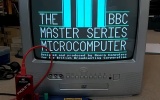
It's been quite a while since I posted about my Z80 Computer project. This is a home-made Z80 computer I built back in 2010 that features a 10MHz Z80 CPU with 64KB RAM that runs CP/M 3. It can drive an internal LCD, TV or VGA monitor at 320x240 (monochrome only) and unfortunately is a project I was never too happy with due to several compromises I had to make in its design – though at the time I was happy enough I got it to work at all! The video output was limited by both my choice to use an internal graphical LCD and the limitations of the dsPIC33F I chose to use to drive it and the software was all a bit half-baked.
A parallel port and a demonstration of the Z80 computer
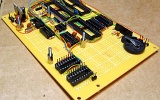
The last piece of hardware to add to the computer was a parallel port. These have eight data lines and nine assorted control and status lines. My last two 8-bit I/O expanders provide sixteen of these seventeen lines, and the final one was provided by the DS1307 real-time clock chip which happily has a spare pin on it that can be used as an output. This parallel port can be used to print from the computer. Some software has printing capabilities built in (such as the text editor VEDIT Plus), but by pressing Ctrl+P in CP/M any text sent to the display will be simultaneously sent to the printer.
A clock and a serial port for the Z80 computer

At the end of the previous entry I mentioned that I was going to start developing my own programs for the Z80 computer. The first is a graphical clock, taking advantage of my implementation of the BBC Micro's VDU commands and the ability to use those commands to draw graphics onto the screen as well as text:
I have uploaded the code and binary to my site for anyone who is interested, though it will only work on a machine running CP/M 3 and that is equipped with a display that implements a handful of BBC Micro VDU commands.
Booting CP/M 3 from an SD card
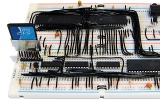
Up to this point I have been running CP/M 2.2 on the Z80 computer. CP/M 3 adds a number of useful features, including the following:
Support for more than 64KB RAM via banked memory. Standardised access to real-time clock for file date and time stamping. Improved text entry on the command-line when using the memory-banked version, such as the ability to move the cursor when editing and recall the previously entered line. Support for disks with physical sectors larger than the default record size of 128 bytes.
Comments ATmega644P AVR CP/M DS1307 Electronics SD card Z80 Z80 computer
Keyboard input and RAM disks make CP/M more useful
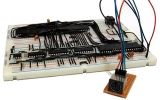
The hardware for the computer has changed in (mostly) subtle ways since the last post, with the exception of a PS/2 socket for connection to a keyboard. PS/2 keyboards (which use the same protocol as the older AT keyboard) communicate with the host by clocking data in either direction (keyboard to host or host to keyboard) over two wires, appropriately named "clock" and "data". An AVR pin change interrupt is used to detect a change in state of the clock line and either input or output a bit on the data line depending on the current direction of data transmission.
Comments ATmega644P AVR CP/M Electronics Keyboard Z80 Z80 computer
Combining a Z80 and an ATmega644P to boot CP/M
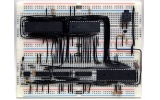
I've been working on a new Z80 computer over the last few days. I would say that I had been working on the existing Z80 computer were it not for the fact that this a completely new design. The previous computer had two 32KB RAM chips to provide a total of 64KB RAM. To run a user program you need to get it into RAM somehow, so I also included a 128KB ROM chip which occupied the lower 16KB of the Z80's address space to provide the fixed operating system that could be used to load programs. By adding memory banking hardware I could select one of eight 16KB pages of ROM.
Thinking about CP/M
It's been some time since I worked on my Z80 computer project, but the recent electronics projects I've completed have got me thinking about it again. Click to watch the video on YouTube I did record a video to demonstrate the basic parts of the computer and some of its flaws a few months ago, which can be seen above. However, I'm now thinking of a more radical redesign than fixing the I/O board's shortcomings. One of the reasons for my lack of motivation is that even if I did get something working I wouldn't have much software to run on it; it would be a lot of work to write software that only ran on that one particular machine.